
Technical Introduction
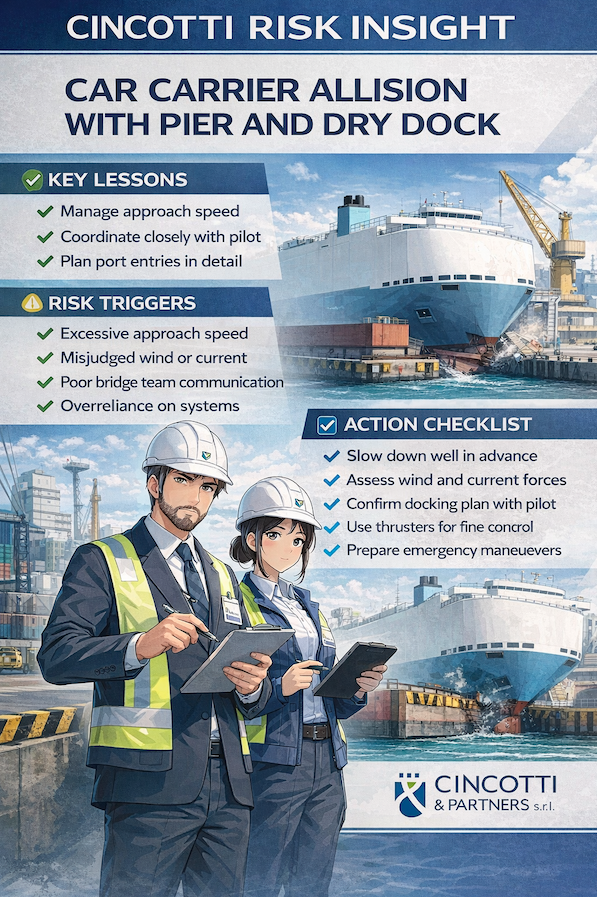
The Britannia P&I incident case study concerning a car carrier allision with a pier and dry dock highlights a high-severity operational risk typical of port manoeuvring environments. Such events occur predominantly in confined waters where human factors, environmental forces, and navigational decision-making intersect under time pressure.
For fleet operators and marine brokers managing RoRo and car carrier portfolios, this scenario directly impacts P&I exposure, Hull & Machinery claims, and third-party liability.
Incident Dynamics and Root Risk Triggers
Technical analysis indicates recurring operational contributors:
- Excessive approach speed
- Misjudgement of wind and current forces
- Suboptimal bridge team coordination
- Restricted manoeuvring space in congested ports
- Overreliance on systems instead of proactive navigation control
From an insurance standpoint, a single allision can trigger multi-layer exposure:
- Third-party infrastructure damage (P&I)
- Hull structural damage (H&M)
- Off-hire and operational disruption
Strategic Insurance Implications (P&I & H&M)
This type of casualty is particularly relevant for underwriting evaluation because:
- Port incidents show higher frequency than open sea casualties
- Third-party liability costs can escalate rapidly
- Loss records directly influence renewal negotiations and premium positioning
Within a structured fleet risk framework (e.g., Canvas-based monitoring), these incidents must be logged as operational risk indicators, not isolated events.
Operational Lessons for Masters and Shipowners
Preventive risk control must be procedural and behavioural:
- Active Bridge Resource Management (BRM)
- Structured pilot communication
- Pre-manoeuvre risk assessment
- Speed and inertia control discipline
- Port entry contingency planning
Strategic Conclusion
Port allisions are rarely random accidents; they are operational risk signals.
For RoRo and car carrier fleets, integrating navigational discipline with P&I and H&M risk governance is essential to protect both claims performance and long-term insurability.
Open Question:
Is your fleet’s port manoeuvring protocol aligned with modern P&I loss prevention standards?
Source & Reference: Britannia P&I Club – BSafe Incident Case Study
#MarineInsurance #PIClub #ShippingRisk #PortSafety #CarCarrier #HullMachinery #MaritimeRisk
#Underwriting #LossPrevention #MarineClaims
#Risk #Responsibility
“Knowledge, precision, responsibility — every day in shipping and beyond.”
