
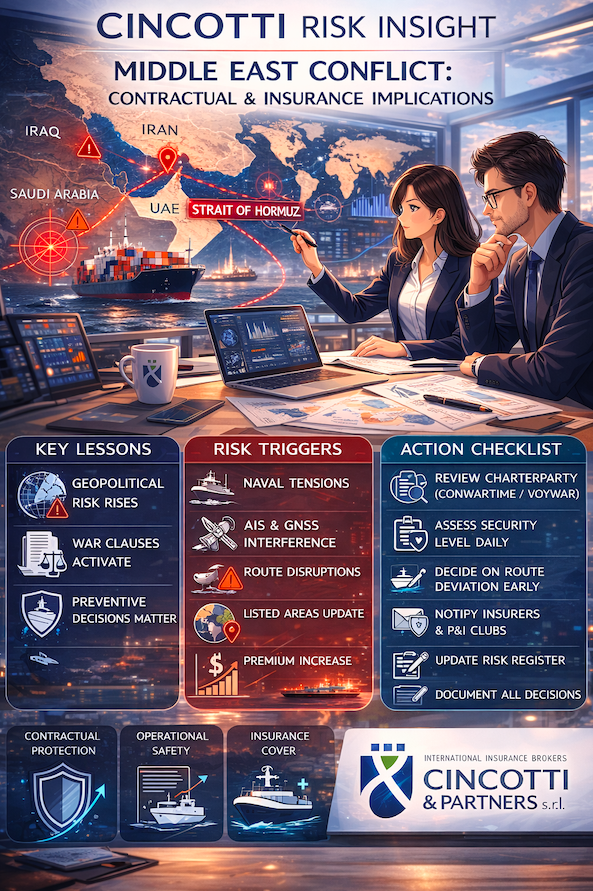
Escalating military tensions involving Israel, Iran and regional actors are rapidly deteriorating the maritime security environment across the Persian Gulf and surrounding strategic waterways.
For the shipping industry, this situation is not merely geopolitical.
It is operational, contractual and insurance-driven.
Decisions taken by the Master, the wording of charterparty clauses and the structure of insurance programmes all become decisive factors in risk management.
Maritime security deterioration in the Gulf
Security assessments indicate a high operational risk environment in the Strait of Hormuz and adjacent waters.
Key threats reported include:
- aggressive naval approaches
- vessel harassment and shadowing
- AIS and GNSS spoofing or jamming
- potential targeting of commercial shipping
In such circumstances maritime traffic may effectively slow or halt, even without a formal closure of the sea lanes.
The importance of war risk clauses in charterparties
Contractual implications arise when a vessel may be exposed to war risks.
Standard BIMCO clauses such as:
- CONWARTIME 2013 / 2025 (time charters)
- VOYWAR 2013 / 2025 (voyage charters)
allow owners or the Master to refuse or deviate from a route if the vessel may be exposed to war risks.
The wording “may be exposed” establishes a relatively low threshold, enabling preventive safety decisions aimed at protecting the vessel, crew and cargo.
Deviation decisions and cost allocation
One of the most complex issues concerns who bears the cost of deviation.
This will generally depend on:
- the wording of the war risk clause
- any contractual routing agreements
- whether the risk environment has materially changed since the charterparty was concluded
Where a Master’s decision is reasonable and based on safety considerations, contractual protections may apply.
However, each situation must be assessed case by case.
Insurance considerations
Geopolitical escalation also affects insurance arrangements.
Potential implications include:
- rising war risk premiums
- evolving Joint War Committee listed areas
- operational implications for P&I and H&M cover
- growing relevance of electronic navigation interference risks
Shipowners and operators must therefore maintain dynamic and continuously updated risk assessments.
Strategic conclusion
The Middle East conflict highlights a fundamental truth in modern shipping.
Geopolitical risk is not only a military matter.
It is a contractual, operational and insurance challenge.
Ultimately, decisions taken on the bridge, in charterparty negotiations and within insurance programmes shape the balance between safety, commercial continuity and liability exposure.
Open question
Are current war risk clauses in charterparties sufficiently robust to manage the evolving geopolitical risks facing global shipping?
Source & Reference
Gard — Maritime Insurance Insight
https://gard.no/en/insights/the-middle-east-conflict-contractual-and-insurance-implications/
#shippingrisk
#marineinsurance
#warinsurance
#charterparty
#maritimesecurity
#straitofhormuz
#shippinglaw
Cincotti & Partners — Marine Insurance & Risk Advisory
Knowledge, precision, responsibility — every day in shipping and beyond.
