
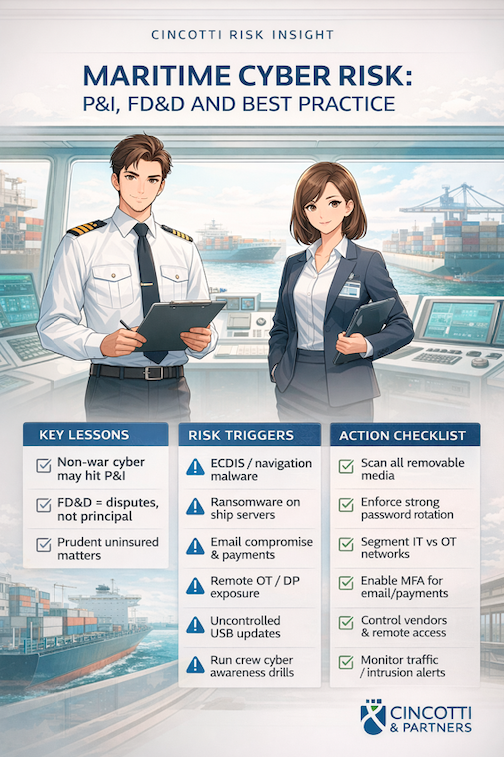
Cyber risk is no longer an “IT topic”. It is now a direct driver of navigational safety, operational continuity, third-party liabilities and charterparty disputes. The American Club’s Cyber Awareness guidance is explicitly aimed at shipowners, operators and shipboard crews to help them navigate cyber risks arising from increasing technical complexity on ships.
The key P&I point many miss
The American Club/ABS overview explains that, generally, International Group P&I rules do not automatically exclude claims arising from cyber incidents, unless the incident is considered an act of war or terrorism.
Operationally, that means the third-party consequences of a non-war cyber incident may fall within standard P&I, but Members are expected to act as prudent uninsureds and take reasonable steps to prevent and mitigate cyber exposures
Where cyber hits ship operations
Impacts include loss of safety/maintenance records, locked-out critical applications (navigation, cargo, safety), exposure of personal data, loss of control of automated systems (autopilot, alarms, machinery worst cases grounding/collision leading to property damage, injury and pollution.
Four practical scenarios: insurance impact and controls
1) ECDIS / application server infection: “ready to sail” but unable to operate safely
A paperless vessel suffers an ECDIS malware event causing multi-day delay and large costs. The pmanaging_cyber_risksontractual consequence: charterers may argue off-hire (equipment breakdown preventing full working). FD&D may respond to the dispute handling (lawyers/experts), not the principal amount in dispute. managing_cyber_risks
If delay affects perishable cargo and triggers cargo claims/arrest, P&I may respond to cargo liabilities and related security.
Controls: removable media governance (USB), MoC for updates, dedicated scanning/anti intrusion detection.
2) Ransomware driven by weak password governance
The overview links recurring compmanaging_cyber_risksrd policy and exposed remote management. Effective controls: perimeter firewalls, segmentation/VLANs, strong password rotation, removal of managing_cyber_risksials, and layered insider-threat measures. managing_cyber_risks
3) Email compromise and diverted payments: usually not P&I
For misdirected payments, the paper is clear: typically outside P&I because there is no third-party liability arising from the operation of the entered vessel; however FD&D with recovery actions and legal costs.
Controls: anti-phishing training, 2FA, access governance, intrusion prevention, and reduced social exposure.
4) OT compromise (e.g., DP) causing physical damage: P&I becomes central again
A DP “hack” leads to loss of cmanaging_cyber_risksa fixed platform, damage, fire, injuries and potential pollution. The paper describes the claims logic and the interaction between H&M collision liability and P&Ifor liabilities not covered elsewhere, plus FD&D for contractual disputes caused by service failure/delay.
Controls: third-party/OEM governance, secure updates, protected remote connections, one-way gateways where appropriate, and traffic monitoring.
The strategic takeaway for shipowners and operators
Cyber is not just “busimanaging_cyber_risksis a casualty trigger. From a P&I/FD&D standpoint, outcomes depend on:
- the nature of loss (third-party liability vs pure financial loss)managing_cyber_risksprudent uninsured* behaviour,
- disciplined IT/OT separation supported by training, procedures and technical controls.
Source & reference: American Club Cyber Awareness hub and ABS/American Club overview (Oct 2020).
#MaritimeCyber #CyberRisk #PandI #FDandD #ECDIS #Ransomware #ShippingRisk
“Knowledge, precision, responsibility — every day in shipping and beyond.”
