
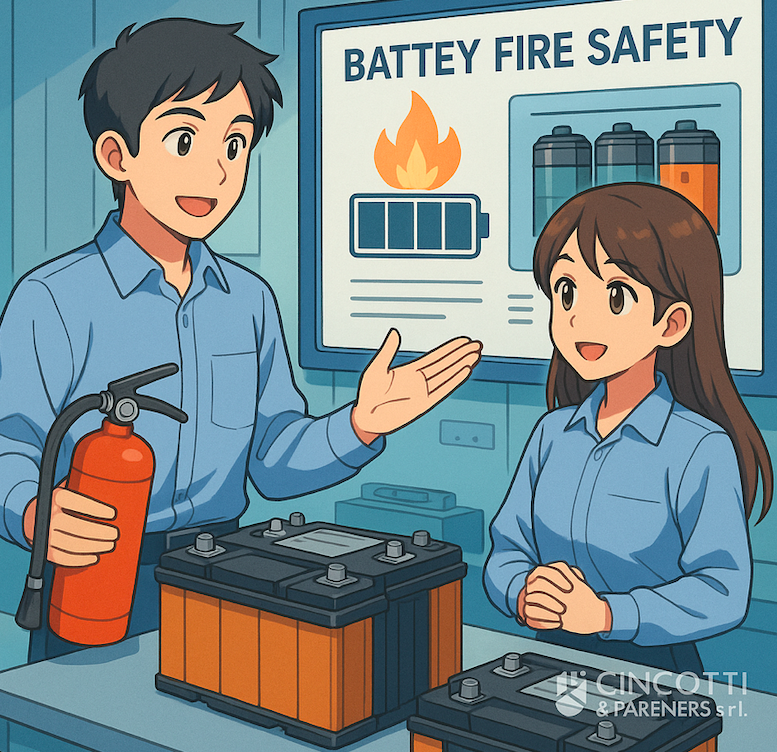
Inspired by the West of England P&I Club’s latest technical insight
Source: West of England P&I Club – “Lithium-ion batteries: Closing the fire safety gap”
Full article: https://www.westpandi.com/news-and-resources/news/december-2025/lithium-ion-batteries-closing-the-fire-safety-gap/
Lithium-ion batteries have become an integral part of modern maritime operations — as cargo, within electric vehicles carried on board, and as core components of onboard energy systems. Yet their fire behaviour diverges sharply from conventional risks, exposing a safety gap that traditional systems and training are not yet equipped to manage.
At the centre of this challenge lies thermal runaway, a rapid, self-accelerating exothermic process that can be triggered by overcharging, mechanical damage or inadequate heat dissipation. Once initiated, it may lead to venting of flammable gases, propagation between cells, and multiple reignitions. These characteristics make Li-ion fires uniquely complex at sea, where space constraints and environmental conditions limit the applicability of shore-based firefighting strategies.
Traditional suppression systems — CO₂, foam, water mist — often cannot guarantee predictable or lasting controlwhen confronted with the heat output and re-ignition potential of Li-ion events. Full immersion, frequently effective on land, is rarely feasible aboard ships.
This creates a tangible and widening gap between what vessels are equipped to do and how Li-ion batteries actually behave during failure.
Understanding the Real Safety Gap
Recent insights emphasise three critical structural weaknesses:
1. Insufficient training
Most crew training programmes still assume classical fire dynamics. They do not address the unique escalation pathways of thermal runaway, nor the operational realities of Li-ion cargo incidents in enclosed spaces.
2. Inadequate onboard equipment
Current detection and suppression systems were not designed with Li-ion chemistry in mind. Early identification of off-gas events, thermal anomalies, and pre-ignition indicators remains inconsistent across the industry.
3. Regulatory misalignment
Existing frameworks — including SOLAS — have not yet fully caught up with the accelerating integration of Li-ion technologies in maritime transport. Clear, prescriptive standards for handling, monitoring and firefighting are still evolving.
What Closing the Gap Requires
Bridging this divide calls for more than incremental updates. It requires:
- Specialised training for crew and operational teams, focused on Li-ion failure signatures, escalation patterns and safety protocols.
- Adapted fire-fighting tools, from advanced thermal monitoring to containment units and dedicated cooling technologies.
- Updated regulatory frameworks, reflecting the unique risks tied to energy-dense modern battery systems.
- Collaborative innovation between shipowners, insurers, classification societies and regulators.
The maritime sector cannot rely on legacy assumptions. Li-ion risk is not hypothetical, nor futuristic — it is immediate, operational and structurally different from anything ships have managed before.
Closing Insight
Lithium-ion technology brings immense value to shipping, but also demands a new level of preparedness, awareness and operational discipline. As battery-powered systems scale and the volume of Li-ion cargo rises globally, the industry must adopt a safety culture as dynamic as the technology it seeks to manage.
What steps is your organisation taking to align fire safety practices with the realities of lithium-ion battery behaviour?
Knowledge, precision, responsibility — every day in shipping and beyond. ⚓️
