
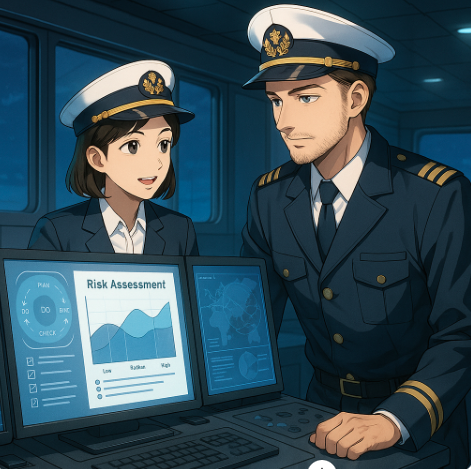
🌊 Breaking the Chain of Human Error: How Risk Assessment Defines Modern Maritime Safety
Risk, human error, and prevention — three words shaping the next decade of maritime safety. ⚓️
In Loss Prevention Bulletin Vol. 51, the Japan P&I Club brings forth a powerful insight: nearly 90% of marine casualties stem from a chain of human errors.
The real challenge lies not in responding to accidents — but in breaking that chain before it forms.
The Bulletin describes a threefold strategy that redefines how we approach safety at sea:
- Bridge & Engine Room Resource Management (BRM/ERM) – ensuring that communication and teamwork act as the first barrier against error. Even the most skilled Masters and Chief Engineers can make mistakes; what saves lives is the crew’s ability to detect, react, and correct collectively.
- 4M5E Analysis – a systematic approach developed by NASA and adapted for maritime safety, examining every incident through Man, Machine, Media, and Management, and countering each through Education, Engineering, Enforcement, Example, and Environment.
- Risk Assessment in Practice – a structured process to identify hazards, measure likelihood and severity, and apply controls before exposure occurs. It’s not merely a checklist, but a mindset: a shift from “follow-up safety” to “front-end prevention.”
At its core, risk assessment means transforming uncertainty into shared awareness — between ship, shore, and management. It creates a proactive culture that prioritizes learning, open communication, and continuous improvement rather than mere compliance.
The Bulletin also highlights the importance of risk communication as the bridge between “safety” and the “sense of security.”
Safety comes from systems and standards; the sense of security arises from trust and transparency — when crew and management communicate openly, share knowledge, and act on a unified understanding of risk.
This is where leadership becomes culture:
not simply ensuring that procedures exist, but that every officer and seafarer believes in their purpose.
In the words of the report, “Safety cannot exist if countermeasures remain confined to the desk of the Master or Chief Engineer.”
True safety emerges when understanding flows — from the bridge to the engine room, from ship to shore.
📘 Read the full document (Japan P&I Club – Loss Prevention Bulletin Vol. 51, June 2021)
🔗 https://www.piclub.or.jp/wp-content/uploads/2021/06/Loss-Prevention-Bulletin-Vol.51_Full.pdf
Knowledge, precision, responsibility — every day in shipping and beyond. ⚓️
#Maritime #RiskAssessment #HumanError #SafetyCulture #Leadership #ShippingCommunity #JapanPICLUB #Operations #RiskManagement #KnowledgeSharing
