
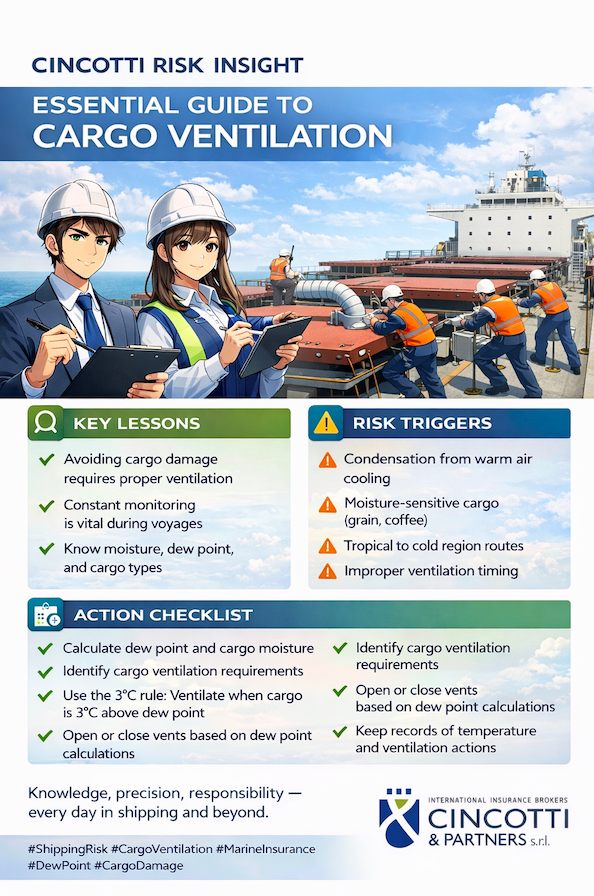
Loss prevention guidance published by Britannia P&I Club highlights that improper cargo ventilation can generate internal condensation within cargo holds, leading to cargo deterioration and potential insurance claims.
Understanding temperature, humidity and dew point dynamics is therefore essential for risk management in shipping operations.
How condensation forms inside cargo holds
Condensation occurs when warm humid air contacts colder surfaces.
In maritime transport this situation commonly arises during voyages that cross multiple climate zones, for example:
- voyages from tropical to colder regions
- temperature fluctuations during the voyage
- ventilation conducted at the wrong time
When this happens, moisture contained in the air condenses into water droplets on cargo surfaces or on the internal structure of the hold.
This phenomenon is generally referred to as:
cargo sweat or ship sweat.
The importance of dew point calculations
The key parameter for deciding whether to ventilate cargo holds is the dew point.
Dew point represents the temperature at which air becomes saturated with moisture and condensation begins to form.
A widely accepted operational rule in shipping states:
ventilate cargo holds only when the outside dew point is lower than the hold dew point.
If this condition is not met, ventilation may introduce additional moisture and increase the risk of cargo damage.
Cargo types most exposed to moisture damage
Certain cargoes are particularly vulnerable to condensation.
Typical examples include:
- grain cargoes
- coffee
- agricultural commodities
- steel products
- packaged moisture-sensitive goods
Improper ventilation in these cases may lead to:
- mold formation
- corrosion
- cargo deterioration
- cargo claims and disputes
Ventilation as a core loss prevention practice
Effective cargo ventilation requires structured operational procedures.
These generally include:
- continuous temperature monitoring
- dew point calculation inside and outside the hold
- ventilation log recording
- cargo-specific ventilation assessment
These practices are essential not only to protect cargo but also to demonstrate operational due diligence in case of insurance claims.
Strategic conclusion
Cargo hold ventilation is not a routine mechanical action.
It is a technical decision based on environmental data, cargo characteristics and voyage conditions.
From a marine insurance perspective, proper ventilation management remains a cornerstone of cargo loss prevention strategy.
Open question for maritime operators
Are your vessel ventilation procedures based on documented dew point calculations?
Source & Reference
Britannia P&I Club — Loss Prevention Insight
Essential Guide to Understanding Cargo Ventilation
https://britanniapandi.com/wp-content/uploads/2025/02/Britannia-Loss-Prevention-Insight-Essential-Guide-To-Understanding-Cargo-Ventilation.pdf
#ShippingRisk
#CargoVentilation
#MarineInsurance
#CargoDamage
#LossPrevention
#DewPoint
#MaritimeRisk
Knowledge, precision, responsibility — every day in shipping and beyond.
