
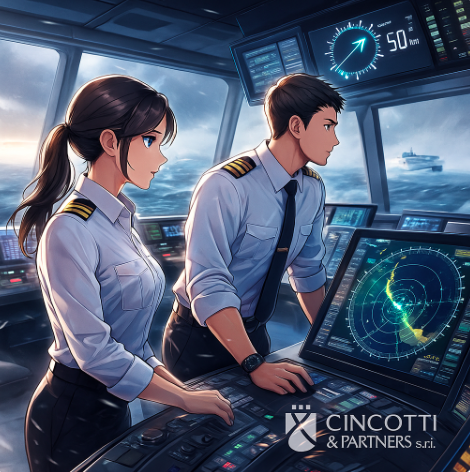
Maritime accidents rarely erupt from a single failure. More often, they emerge quietly — a string of small vulnerabilities aligning in the wrong moment. Britannia P&I Club’s Loss Prevention team captures this dynamic with remarkable clarity in its Incident Case Study No. 27 (June 2025), analysing the grounding of a ro-ro ferry during departure from Calais under severe weather conditions.
BSafe-Case-Study-27-Grounding-o…
The case, reconstructed through ECDIS tracks, control console data and human-factor analysis, is a powerful reminder of how operational discipline, technical reliability and cultural safety practices converge — or collapse — in moments that matter.
A Routine Departure That Became Anything But Routine
The ferry, trading frequently between Dover and Calais, departed into conditions already at the limit of safe manoeuvring:
- 50+ knots of wind on the starboard beam
- Bow thruster instability observed earlier the same morning
- Main engine overload alarms triggered more frequently after the switch from MGO to ULSFO
- Schedule pressure after delayed berthing
Within minutes, the ship lost its ability to counteract a rapid wind-induced swing. A mismanaged transfer of steering control, combined with the limitations of high-lift rudders and inconsistent thrust availability, left the vessel exposed. It contacted a jetty and grounded shortly afterward.
No injuries occurred — but the impact caused port disruption, structural damage, and the vessel was forced out of service.
Where the Chain Began to Break
Britannia’s analysis points to several converging contributors:
1. Weather at the Threshold
Operations took place at the edge of the vessel’s handling capability. In such conditions, even a minor lapse consumes the entire safety margin.
2. Equipment Reliability Concerns
The bow thruster had already tripped once.
The main engines had shown persistent performance issues post-fuel change.
When critical systems signal unreliability, assuming full capability becomes a structural vulnerability.
3. Absence of a Pre-Departure Briefing
A structured BRM briefing could have aligned expectations, clarified contingencies, and raised awareness of equipment limitations.
4. Human Factors Under Time Pressure
Real or perceived commercial pressure risks distorting judgement. The safest decision may not align with the timetable — and that conflict must be recognised proactively.
5. Crew Familiarisation Gaps
The helmsman was unfamiliar with the bridge wing steering transfer and with high-lift rudder behaviour.
Familiarisation is not a procedural formality — it is a core safety barrier.
Bridge Resource Management: More Than a Procedure
BRM is not a formality.
It is the structural foundation that prevents small anomalies from escalating into large-scale incidents. When BRM culture weakens, teams lose the ability to:
- challenge assumptions
- detect early warning signs
- coordinate under stress
- perform seamless control transfers
This case shows how the absence of a briefing indirectly shaped every subsequent weakness.
Management of Change: An Overlooked Contributor
Switching from MGO to ULSFO represents a major operational change.
Its consequences on engine performance were measurable and persistent — yet normalised.
A proper Management of Change cycle would have demanded:
- escalation of recurring issues
- special monitoring
- engineering review
- training adjustments
- readiness to revert
Ignoring small symptoms allowed them to become baseline conditions.
Why This Incident Matters for the Industry
This is not just a shiphandling case.
It is a systems case: an interplay of technology, culture, communication, and pressure.
It demonstrates how resilient operations depend on:
- strong procedural discipline
- realistic assessment of environmental limits
- reliable equipment
- a trained, confident bridge team
- the courage to delay when conditions are marginal
The outcome was controlled — but could easily have been catastrophic under slightly different circumstances.
A Strong Takeaway for Operators and Navigators
Britannia’s Loss Prevention Case Study reinforces a fundamental truth:
Safety is constructed before the manoeuvre begins.
Safety lives in:
- the quality of the briefing
- the accuracy of the assessment
- the honesty about equipment reliability
- the handling of time pressure
- the integrity of decision-making
When fundamentals are strong, crises remain manageable.
When fundamentals erode, even familiar waters become hazardous.
Download the Full Britannia Loss Prevention Case Study
🔗 Britannia P&I Club – Incident Case Study No. 27
https://britanniapandi.com/wp-content/uploads/2025/06/BSafe-Case-Study-27-Grounding-of-Ferry.pdf
#ProfessionalInsights #KnowledgeSharing #Leadership #FutureThinking #Innovation
#Maritime #Shipping #FerryOperations #PAndI #LossPrevention #Safety #RiskManagement
#BRM #Navigation #Operations #MarineEngineering #Compliance
#Excellence #Responsibility #Collaboration #Mindset #Resilience
Knowledge, precision, responsibility — every day in shipping and beyond. ⚓️
