
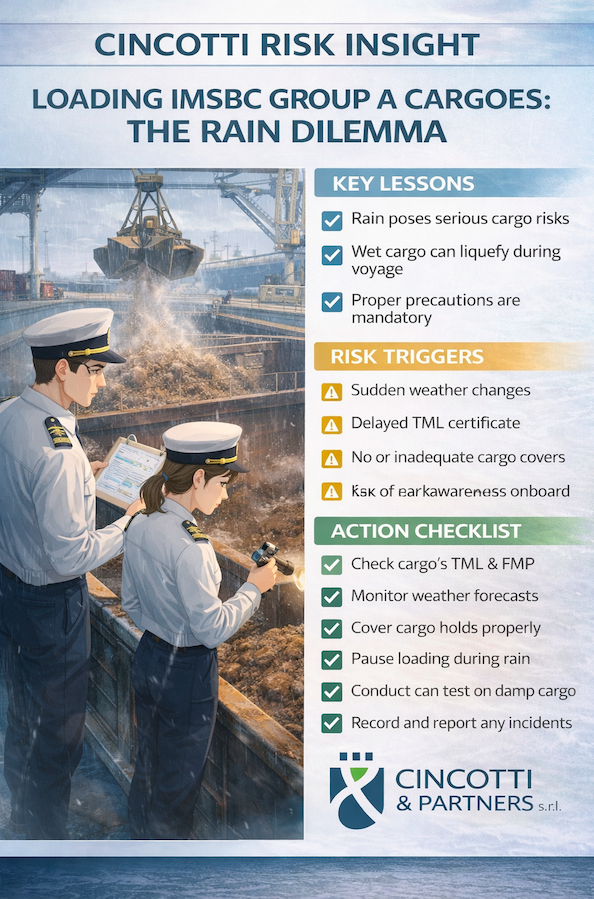
Bulk cargo operations involving IMSBC Group A cargoes remain one of the most sensitive risk areas in maritime transport. The issue of loading during precipitation continues to challenge both operational decision-making and compliance frameworks.
The non-negotiable principle: TML
The IMSBC Code is clear:
Cargo moisture content must never exceed the Transportable Moisture Limit (TML).
Rain exposure directly increases the risk of cargo liquefaction, which can lead to catastrophic loss of vessel stability.
Is rain loading ever allowed?
Contrary to common belief, the Code does not impose a total prohibition. However, loading under rain is only permitted under strict conditions:
- Moisture must remain below TML at all times
- Preventive measures must limit water ingress
- Cargo-specific schedules must be followed
- Procedures under Section 4.3.3 IMSBC Code must be applied
The decisive factor: Moisture Management Plan
The critical requirement is a competent authority-approved Moisture Management Plan.
This must ensure:
- Continuous sampling and testing
- Active moisture monitoring
- Structured operational procedures
Without such a plan, rain loading is not permitted.
Operational accountability
While the primary responsibility lies with the shipper, vessels must take an active verification role.
Shipowners should:
- Request the approved plan
- Verify real-time implementation
- Suspend operations if compliance fails
Strategic conclusion
The real risk is not rain.
It is uncontrolled moisture.
In modern bulk shipping, safety is no longer reactive.
It is procedural, documented, and verified.
CTA
Are your onboard procedures robust enough to manage TML risk under adverse weather conditions?
Source & Reference
West of England P&I Club – Loss Prevention, January 2026
#IMSBC #BulkShipping #TML #MarineRisk #Pandi #ShippingSafety #LossPrevention #LiquefactionRisk
Knowledge, precision, responsibility — every day in shipping and beyond.
