
Technical introduction
The maritime industry is accelerating toward low-emission fuels, with methanol emerging as a scalable and operationally viable solution. However, its adoption introduces a fundamentally different risk profile compared to conventional fuels.
Physical properties: controlled but hazardous
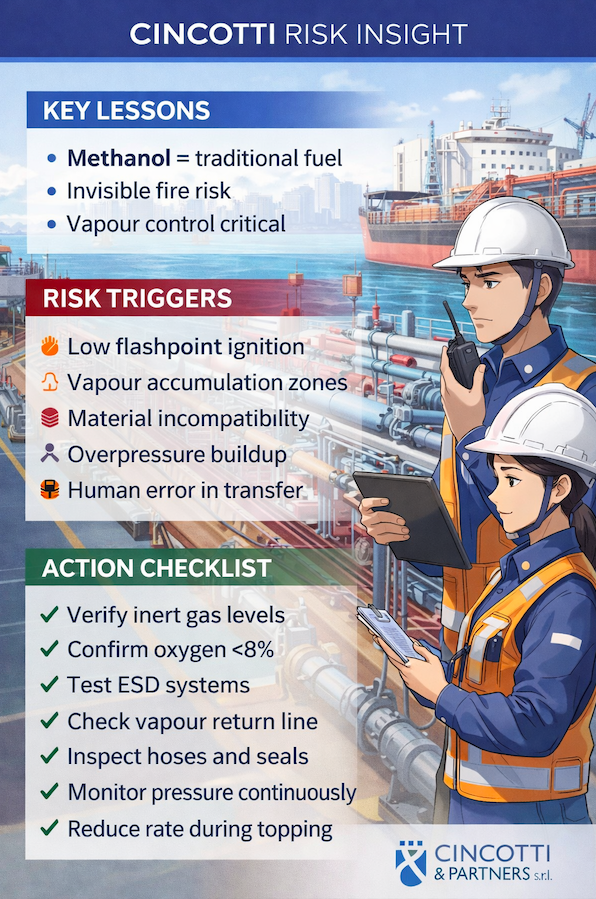
Methanol combines ease of handling with high-risk characteristics:
- Low flashpoint (~11°C)
- Vapours heavier than air
- Nearly invisible flame
- High toxicity
This creates a hidden-risk environment, especially during transfer operations.
Core risk clusters
Six primary hazards define methanol handling:
- Fire and explosion potential
- Asphyxiation risks
- Material compatibility issues
- Vapour overpressure
- Tank sloshing dynamics
- Invisible flame detection challenges
Methanol is not “safer”—it is risk-different.
Safety architecture
Safe operations rely on integrated systems:
- Cofferdam-protected tanks
- Inert gas systems (O₂ < 8%)
- Controlled venting and flame arrestors
- Hazardous zone classification
- Emergency shutdown systems
Safety is engineered—not improvised.
Bunkering operations: the highest exposure
Critical controls include:
- Joint Plan of Operation (JPO)
- Pre-transfer checklist validation
- Continuous monitoring
- Vapour return system
- Controlled topping-off phase
Any anomaly requires immediate shutdown.
Fuel quality & contractual exposure
Under BIMCO Methanol Annex:
- ≥99.85% purity
- Strict contaminant limits
- Mandatory BDN documentation
- Charterer liability
Risk extends beyond operations into legal and insurance domains.
Crew competency
IGF Code requires:
- Certified training
- Advanced operational competence
- Real bunkering experience
Human factor = critical risk control layer.
Strategic conclusion
Methanol is not just a fuel shift.
It is a risk paradigm shift.
Operators who adapt structurally gain resilience.
Those who don’t face amplified exposure.
Is your operation engineered for methanol risk—or simply adapting fuel supply?
Source
UK P&I Club – Risk Focus: Methanol Bunkering
#MethanolFuel #MarineRisk #ShippingSafety #AlternativeFuels #IGFCode
#MarineInsurance #RiskEngineering
Knowledge, precision, responsibility — every day in shipping and beyond.
