
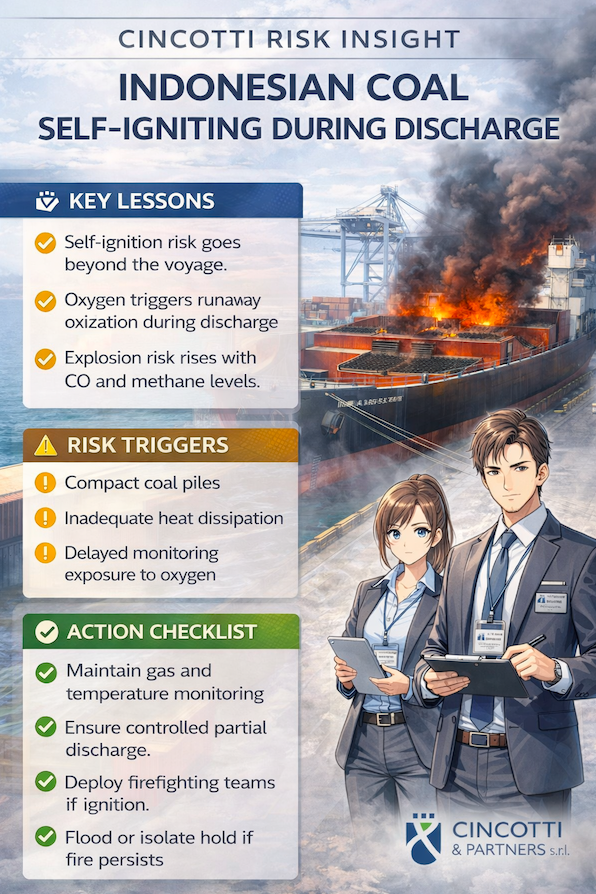
Technical Introduction
Indonesian coal shipments represent a highly underestimated risk in bulk shipping. Even when fully compliant with IMSBC Code parameters during the voyage, spontaneous combustion may occur not at sea, but during discharge operations.
The key factor: oxygen reintroduction.
Incident Dynamics
A bulk carrier loaded Indonesian coal and maintained sealed cargo holds throughout the voyage.
- Gas readings and temperature: within limits
- No abnormalities detected
During discharge:
- Smoke from hold no.3
- Temperature: 66°C
- Methane: 120% LEL
- CO: > 3,680 ppm
Then:
- Hold no.4: 69°C – 144% LEL – CO > 10,000 ppm
- Explosion risk escalated
Technical Risk Analysis
The mechanism:
➡️ Coal oxidation → heat generation → runaway reaction
During voyage:
- Limited oxygen → slow reaction
During discharge:
- Oxygen exposure
- Heat accumulation
- Accelerated oxidation
📌 Key insight:
The risk is delayed, not absent.
Critical Risk Triggers
- Compacted coal piles (thermal insulation)
- Oxygen ingress during discharge
- Heat accumulation
- Rising CO and methane levels
- Delayed detection
Emergency Response
Actions taken:
- Fire teams deployed
- Seawater cooling
- Controlled discharge
- Final measure: flooding cargo holds
➡️ Fire successfully extinguished
Strategic Conclusion
This case confirms a critical operational truth:
➡️ The highest risk lies in operational transition phases.
Operators must:
- Maintain monitoring during discharge
- Understand oxygen exposure dynamics
- Anticipate delayed combustion
CTA
Are your discharge procedures aligned with coal self-heating risk scenarios?
Source & Reference
The Swedish Club – Casebook 2023
#ShippingRisk #BulkCarrier #MarineInsurance #CoalCargo #IMSBC #RiskManagement #Pandi #MaritimeSafety
Knowledge, precision, responsibility — every day in shipping and beyond.
