
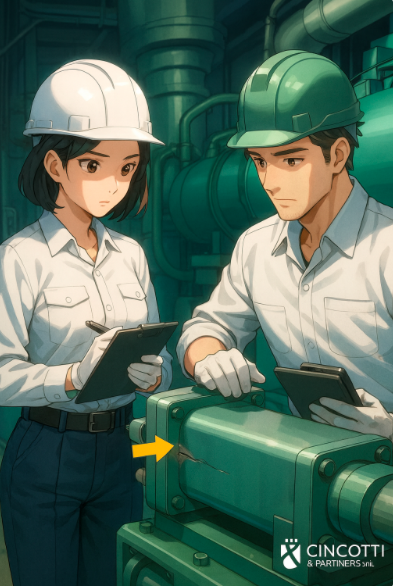
The U.S. Coast Guard has issued Safety Alert 20-25, drawing attention to a critical and recurring vulnerability affecting vessels fitted with Wabtec EPA Tier 4 / IMO Tier III marine engines. Recent investigations revealed multiple cases of EGR cooler weld seam cracks, all occurring well before their designated overhaul interval.
In several incidents, these failures led to coolant leakage, rapidly rising jacket-water temperatures, and ultimately main engine shutdowns — including a propulsion loss event that required tow assistance.
Beyond the technical failure itself, the USCG highlighted an additional point of concern: Wabtec issued a service notification in December 2024, but this notice was shared only with Channel Partners, not directly with end-users. The result is a knowledge gap that can significantly increase operational risk.
Key Technical Findings
Marine Investigators documented repeated weld-seam cracks on the EGR cooler’s corner section. In total, six failures occurred within two years — all below the expected service life.
Wabtec’s post-event guidance indicates that improper circuit pressure settings, air pockets trapped in off-engine piping, and insufficient water-treatment protocols may accelerate localized overheating or introduce pressure fluctuations that contribute to weld stress.
USCG Recommendations for Owners & Operators
To mitigate propulsion-loss risk, the Coast Guard strongly advises operators to:
- Conduct targeted inspections of EGR coolers, particularly prior to entering or departing port.
- Monitor inlet-pressure behavior and temperature variations for signs of leaks or internal manifold contamination.
- Bleed air from the cooling system after any maintenance involving coolant drainage.
- Ensure cooling circuit pressures are aligned with the vessel’s expansion-tank height.
- Avoid trapped air pockets in off-engine piping and maintain proper coolant water quality.
- Integrate these checks into the vessel’s SMS (Safety Management System), where applicable.
- Contact Wabtec Channel Partners or authorized dealers promptly if failures recur or abnormal readings are detected.
These recommendations remain in force until a permanent engineering solution is developed.
Why This Alert Matters
Propulsion loss is never “just” a mechanical event. It affects:
- Navigational safety
- Operational continuity
- Crew welfare
- Commercial performance
- Insurance exposure (H&M ⟂ P&I implications)
- Reputation and compliance posture
Reliable main-engine availability is a pillar of maritime risk management. Systematic monitoring of EGR performance and weld integrity is now a crucial priority for any fleet operating Tier 4 / IMO III engines.
Access to Full Documentation
The complete Safety Alert and Member Guidance are available for download at the link Here — kindly shared by American Club Member Alert Here.
These materials offer the full technical context, imagery, and investigative details that can support onboard training, superintendent reviews, and engineering audits.
Final Reflection
The USCG’s findings reaffirm how essential proactive engineering oversight is across the maritime sector.
How does your fleet monitor EGR systems, weld integrity, and cooling-circuit behavior — and what improvements are you planning for the next audit cycle?
#MaritimeSafety #MarineEngineering #RiskManagement #Operations #Compliance #ShippingIndustry #PropulsionSystems #SafetyAlerts #FleetManagement #TechnicalGuidance
Knowledge, precision, responsibility — every day in shipping and beyond. ⚓️
