
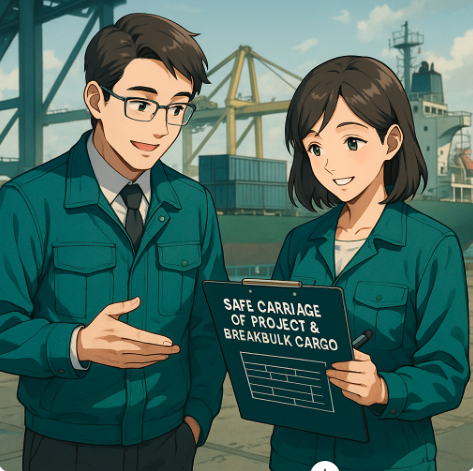
Moving project cargo is anything but routine. Oversized units, high-value components, variable centres of gravity, critical lifting operations—every phase is a high-stakes engineering decision. These shipments demand far more than operational experience: they require disciplined planning, technical precision, and continuous risk awareness.
Steamship Mutual’s Risk Alert 121 – Safe Carriage of Project & Breakbulk Cargo brings the conversation back to fundamentals:
👉 safe transport begins long before the cargo reaches the quay.
1. The Foundation: Pre-Shipment Planning
Effective project cargo management starts with a rigorous feasibility study:
- Verification of the vessel’s structural limits
- Stability calculations and impact of heavy units
- Bridge visibility assessments
- Deck strength and load distribution
- Port feasibility (equipment, berth limits, lifting capacity)
- Review of cargo documents: DG declarations, manifests, packing lists
These steps ensure the vessel, crew, terminals, and equipment are ready for the specific cargo’s demands.
2. Lifting Operations: Zero Margin for Error
Every lift is a potential failure point. RA121 stresses that:
- SWL reductions during tandem lifting must be respected
- Only certified lifting points should be used
- Lifting gear must be inspected and properly rated
- Wooden crates must never be lifted with gear wrapped around the structure
- Centre of gravity identification is non-negotiable
There is no improvisation here—only method.
3. Stowage & Securing: Precision and Uniformity
Once onboard, safety depends on structural compliance and uniform securing systems:
- Adequate dunnage with correct certification
- Proper lashing angles and matching lashing grades
- Avoiding multiple lashings on a single securing point
- Respecting the Cargo Securing Manual (CSM)
- Assessing cradle stability and sea-fastenings quality
- Ensuring additional fittings meet MSL requirements
One weak link can compromise the entire stow.
4. Monitoring at Sea: Staying Ahead of the Weather
Breakbulk and project cargo require continuous attention:
- Weather routing tailored to cargo sensitivity
- Access routes for inspections
- Regular checks of securing systems
- Use of shock, tilt, temperature, and humidity recorders for sensitive cargo
- PPE, safe access, lighting, and atmospheric checks for crew inspections
Monitoring is not optional—it’s an operational safeguard.
5. The Strategic Role of the Marine Warranty Surveyor (MWS)
RA121 strongly recommends independent MWS supervision for:
- Pre-loading inspection
- Verification of lifting plans
- Stowage and securing procedures
- Reporting pre-existing damage
- Oversight of discharge operations
An experienced surveyor reduces exposure for owners, operators, and underwriters alike.
Conclusion: Excellence Through Discipline
Project cargo carriage is a discipline built on foresight, engineering rigour, and collaborative execution.
There are no shortcuts—only preparation, precision, and professional integrity.
🔗 Download the full Steamship Mutual Risk Alert 121 here:
https://www.steamshipmutual.com/sites/default/files/medialibrary/files/RA121%20-%20Project%20cargo_2.pdf
Your turn
How do you approach risk management when handling complex project cargoes?
Your perspective matters—share your experience below.
#️⃣ Hashtags
#Maritime #ProjectCargo #Breakbulk #CargoSafety #ShippingOperations #RiskManagement #MarineInsurance #ProfessionalInsights #KnowledgeSharing #Innovation #Safety #Operations #Excellence
“Knowledge, precision, responsibility — every day in shipping and beyond. ⚓️”
