
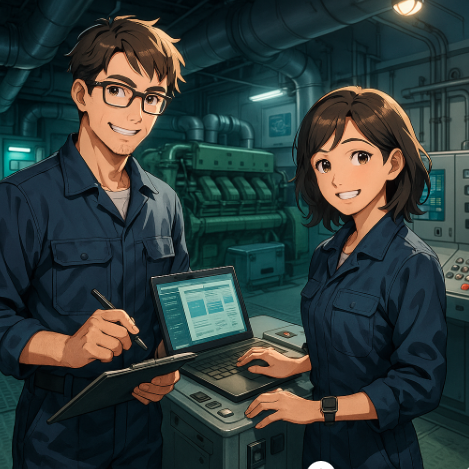
THE HUMAN ENGINE OF SHIPBOARD MAINTENANCE
A perspective shaped by experience — and by the realities we still need to confront as an industry
────────────────────────────────────────────
There is a moment — deep in the engine room or standing a watch alone on deck, surrounded by heat, vibration, steel, and the constant pulse of a living ship — when a simple truth becomes impossible to ignore:
Maintenance is not a technical routine. It is a human commitment.
And that commitment is being tested every day.
Before my life in maritime insurance and technical advisory, I spent years serving onboard as a Chief Officer on deck.
I’ve lived the night watches, the weather windows, the pressure of turnarounds, the fatigue that creeps into the bones, and the responsibility that never fully leaves you — even when you step ashore.
So when I read Skuld’s article
👉 “The Shipshape Struggle in Shipboard Maintenance”
https://www.skuld.com/topics/ship/safety/the-shipshape-struggle-in-shipboard-maintenance/
…it resonated not just intellectually, but personally.
Because I know exactly what it means to maintain a vessel under real conditions — not theoretical ones.
The Real Weight Carried by Today’s Crews
Behind every checklist, I’ve seen exhaustion.
Behind every maintenance delay, I’ve seen the impossible balance between safety, schedule, weather, and manpower.
Skuld captures this reality with uncommon honesty:
Many technical incidents don’t originate in mechanical weakness — they originate in human overload.
Minimal manning.
Compressed port rotations.
Aging vessels with missing records.
Budget-driven decisions.
Cramped spaces, extreme heat, noise, vibration.
Communication gaps that turn routine operations into operational uncertainty.
These are not exceptions.
They are the everyday context in which crews are asked to deliver flawless compliance.
And I’ve been part of that context.
I’ve felt its friction firsthand.
The Insight We All Needed to Hear
Among Skuld’s conclusions, one stands out — because it is exactly what every officer, engineer, and rating has silently wished someone on shore would finally say:
👉 Work must be adapted to the worker — not the worker to the work.
I have seen the difference this makes.
Crews perform at their best when the system respects their limits, their expertise, and their reality.
When they feel supported rather than stretched.
That is when maintenance stops being reactive.
That is when safety becomes more than compliance — it becomes culture.
This Industry Owes Its People More
The maritime sector has never lacked technical excellence.
What it needs now is human-centered operational design.
Because I can tell you from my own experience:
• When manning is insufficient, discipline alone can’t bridge the gap.
• When tools or spares are missing, no amount of dedication can compensate.
• When fatigue becomes normal, risk becomes invisible.
• When communication fails, the ship pays the price — always.
The most advanced PMS collapses if the people executing it are running at 120% capacity.
A New Kind of Leadership
The future of safe operations won’t be shaped only by regulations or technology.
It will be shaped by leaders — ashore and onboard — who understand the lived experience of seafarers.
Leaders who recognise that:
• supporting crews is risk management
• listening is operational efficiency
• empowerment is loss prevention
• ergonomics are safety
• human limits are not negotiable variables
This is the leadership the industry needs now.
This is the leadership that actually moves the needle.
Final Call — and a Question That Matters
With my background at sea and my current work supporting owners, operators, and insurers, I see the same question emerging everywhere:
What would change if we redesigned maintenance around the people who perform it?
And even more importantly:
What stops us from doing it today?
The answer to these two questions may well define the next decade of maritime safety.
Read the original Skuld article here:
👉 https://www.skuld.com/topics/ship/safety/the-shipshape-struggle-in-shipboard-maintenance/
#Maritime #ShippingOperations #ShipManagement #SafetyCulture #HumanFactors
#TechnicalManagement #RiskManagement #Maintenance #PMS #Seafarers
#OperationalExcellence #Leadership #MaritimeInsights #ProfessionalInsights
#Innovation #FutureSkills #CrewWelfare #Resilience
Knowledge, precision, responsibility — every day in shipping and beyond. ⚓️
